Carl von Hassler (1887-1969)
Museum Collections Featuring Works by Carl von Hassler
Highest Auction Prices for Carl von Hassler
Carl von Hassler Sundown in Winter, March 27, 1939 Oil on Canvas 18" x 24", Foothills Sangre De Christo Range New Mexico
Von Hassler experienced another life-altering event two years later when he attended a performance of Buffalo Bill's Wild West Show. His father, a prominent businessman, had helped bring the temporarily bankrupt troupe to Bremen. Thats when I first decided to go to America, he recalled. That opportunity to go abroad finally arrived in 1912 after he finished his naval service and also completed six years at the Düsseldorf Art Academy.
Carl von Hassler, Aspens, c. 1932, Tempra on Board, 16" x 20"
Von Hassler first settled in New York where he studied with members of the Ashcan Group. By 1917, as America prepared to enter World War I, several of the Ashcan painters were drawn to New Mexico, lured by the beauty of its landscape. Ironically, von Hassler heard a very different call. So great was his dedication to his new home he joined the U. S. Army in the fight against his homeland.
In Germany, von Hasslers brother also signed up to fight, literally pitting the family against itelf. When his brother was killed in the war, von Hasslers mother disinherited him, and he decided never to return to Germany. After four years of service he was released from the US Army and, in 1922, von Hassler moved to New Mexico. Instead of following his New York acquaintances to Santa Fe, however, he settled in the up-and-coming town of Albuquerque.
Carl von Hassler, Fall Colors, Oil on Paper, 13" x 18"
The Indian Pueblos of New Mexico were another favorite subject for von Hassler, and he systematically sketched and painted each of the villages. In 1927, he used these studies as the basis for his first important commission: murals for the Pueblo/Deco styleKiMo theater in Albuquerque. The ten-panel painting depicts the legendary Seven Cities of Cibola which the Conquistadores thought were cities of gold but turned out to be native farming villages. The murals were restored in 1989 and still adorn the historic theater.
As von Hasslers career in New Mexico advanced, he concentrated more and more on painting the landscape he had come to love. By the 1930s he was widely known for his ability to capture the moods of the land as it changed through the seasons. He did this with a carefully controlled palette consisting of a limited range of finely modulated color. However, this technique was actually based in his knowledge of the natural world. His friends and students recalled that von Hassler was an expert on nature lore and could name almost any plant that grew in the state.
Carl von Hassler, Looking Towards Jemez, Oil on Canvas, 27" x 36"
In a 1961 newspaper interview, von Hassler talked about the importance of thoroughly knowing the landscape before an artist can paint it effectively. Nature is a great teacher. To be a truly good artist, one has to be first a naturalist. Each area presents its own background and feeling. Arizona is quite different from New Mexico. Our state is very different from Colorado, and so it goes. Unless you get the feel of a place, your painting will lack strength and beauty. His goal was to evoke nature, not manipulate it, and he felt that it was not possible to elaborate on nature with success. I want to place on canvas what I see in nature.
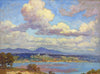
Carl von Hassler, Fast Moving Clouds, c. 1937, Oil on Canvas, 26" x 34"
Not only did von Hassler study and enjoy his subjects, but he also enjoyed the very act of painting and reveled in the feel of various media. He was equally skilled with different kinds of paint, his favorites being oil, egg tempera, and watercolor. At the Academy in Düsseldorf he had studied the chemistry of paint, and throughout his career was known for experimenting with new materials to achieve exactly the colors and textures he wanted.
Carl von Hassler, Springtime New Mexico Valley, c. 1930, Acid Tempra, 16" x 20"
By the 1940s, von Hassler was one of New Mexicos most popular painters and came to be called The Dean of Albuquerque Artists. He seldom showed his work in galleries as he was able to sell most of his paintings privately. He took pride in the fact that they found homes in many countries around the world. Von Hassler also completed major commissions for such notable Albuquerque buildings as the 1939 Albuquerque Airport, Fred Harveys Alvorado Hotel, the Franciscan Hotel, Bank of New Mexico, and First National Bank. Sadly, his ceiling decoration at the Airport is the only of these commissions that have not been removed or destroyed.
Carl von Hassler, Autumn Splendor, c. 1930, Egg Tempera, 12" x 16"
When Carl von Hassler died in 1969, his students fondly remembered him as a stern and demanding teacher, but one who got results. he was a disciplinarian as a teacher and an artist. Most important, he demanded patience and self-discipline in our work, two students recalled. But this was no less than he demanded of himself, always reinforcing his art with his constant search for knowledge. Walter Bambrook, reminisced about von Hassler and his most famous student: Ben Turner and I would go on sketching trips with Carl back in the early thirties... He was always learning something new about New Mexico. He never stopped learning.
Canyon Road Arts, TaosPainters.com, Mark Sublette Medicine Man Gallery, and CarlvonHassler.com wishes to thank Patti Gonzales of the Albuquerque Museum for her assistance with this article.
Von Hassler once told a reporter that he had developed a technique for baking paint at up to 600 degrees so that it would take on a ceramic-like appearance and would be permanently colorfast. Since it was not possible to subject canvas to high temperatures, he also created what he called an atomic substance for use as the ground on which to paint. He was better known, however, for developing an acid tempera paint which bonded with a paper ground. Unfortunately, von Hassler was reluctant to divulge his various formulae, and now very little is known about the paint media he invented.
Top